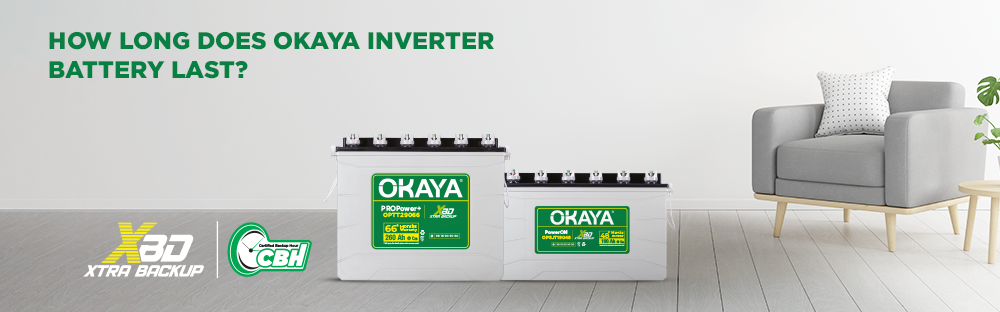
Most inverter batteries last somewhere between 4 to 8 years, though the exact number depends heavily on the battery's build quality, how it's used day to day, and how well it's maintained. This guide breaks down what actually determines inverter battery life, how Okaya's engineering is designed to support it, and the maintenance habits that make the biggest difference.
A battery's lifespan isn't fixed at the point of purchase — it's shaped by several factors working together:
Battery technology and build quality — tubular battery construction, plate design, and internal engineering all affect how well a battery holds up over repeated charge-discharge cycles.
Usage patterns — frequent deep discharges (running the battery down close to empty) wear it out faster than shallow, regular use.
Maintenance and care — routine upkeep like water top-up and terminal cleaning has a direct, measurable impact on longevity.
Correct inverter battery size for the load — an undersized battery working overtime, or an oversized one rarely used to capacity, can both shorten effective lifespan.
Environmental conditions — extreme heat or poor ventilation accelerates wear on any lead-acid battery.
Okaya's UPS battery range is built around Advanced Tubular Technology (ATT), XBD+ (Xtra Backup Design Plus), and Advanced Electrolyte Management (AEMS) — engineering choices aimed specifically at improving how long a battery performs reliably, not just how much it can store on paper.
XBD+ combines an advanced active material composition with optimised internal construction, which Okaya states delivers up to 15–20% longer backup than a standard inverter battery at the same Ah rating, along with faster recharge after a power cut. AEMS, paired with a 6×1 water-inlet layout on Super Jumbo Tubular (SJT) models, is designed to make routine water top-up safer and more convenient — a maintenance step that directly affects how long the battery lasts.
Alongside this, every Okaya XBD+ battery carries Certified Backup Hours (CBH) — tested runtime figures verified by NABL-accredited third-party laboratories and printed on the packaging, so backup performance is based on measured data rather than estimates. (For the full explanation, see Why Certified Backup Hours Matter in Inverter Batteries.)
Tips to Maximise Your Inverter Battery's Lifespan
A few habits make a real difference to how long a battery lasts in everyday use:
1. Check water levels regularly. Tubular batteries need periodic distilled water top-up — typically 1–2 times a year for Okaya's XBD+ range — to keep the plates properly covered and functioning.
2. Avoid deep, frequent discharges. Letting the battery run all the way down repeatedly puts more strain on it than shallow, regular cycles.
3. Keep terminals clean and connections tight. Corrosion or loose connections can affect charging efficiency over time.
4. Match the battery to your actual load. An inverter battery size that's right for your daily consumption — not undersized or excessively oversized — tends to perform more consistently over its warranty period. Okaya's power calculator can help estimate the right capacity based on the appliances you want to back up.
5. Keep the battery in a ventilated, moderate-temperature space. Avoid direct heat exposure or poorly ventilated enclosures where possible.
Okaya's XBD+ battery range spans Super Jumbo Tubular (SJT) and Tall Tubular (TT) construction, with capacities from 90Ah up to 310Ah and warranty terms from 48 to 66 months, structured as a flat period plus a pro-rata period.
|
Capacity |
Warranty (Flat + Pro-Rata) |
|
90Ah |
48 months (24M + 24M) |
|
110Ah |
48 months (24M + 24M) |
|
140Ah |
48 months (24M + 24M) |
|
160Ah |
48 to 60 months, depending on variant |
|
190Ah |
60 months (36M + 24M) |
|
210Ah |
48 to 60 months, depending on variant |
|
230Ah |
60 months (36M + 24M) |
|
260Ah |
66 months (42M + 24M) |
|
310Ah |
60 months (36M + 24M) |
Warranty terms vary by exact model rather than scaling directly with capacity — for instance, the 260Ah model carries a 66-month warranty, longer than the 310Ah model's 60 months. Actual battery lifespan still depends primarily on the maintenance and usage factors covered earlier in this guide, not warranty length alone.
If you're looking for a big inverter battery, Okaya's 310Ah model is currently the largest single-unit option available, built for heavy, extended backup needs in larger homes, offices, or commercial setups. If you're comparing the 300 ah battery price, you can explore this and Okaya's other inverter battery capacities on the shop platform.
The 230Ah Tall Tubular (TT) battery delivers dependable, long-term backup for homes and small commercial setups with higher daily loads. If you're comparing the 220ah battery price, you can explore this and Okaya's other inverter battery capacities on the shop platform.
The 260Ah Tall Tubular (TT) battery is built for consistent energy delivery in homes, offices, and shops with higher backup needs. If you're comparing the inverter battery 250ah price, you can explore this and Okaya's other inverter battery capacities on the shop platform.
For those tracking backup duration at a specific load, 160 Ah battery backup time at 400W sits in the 2 hours 55 minutes to 3 hours 15 minutes range, depending on the exact variant — a useful reference when sizing for a standard 2BHK home.
(For a full price list across every capacity, Okaya's battery price page on the shop platform is updated with current availability.)
Support That Helps Your Battery Last
A battery's practical lifespan also depends on the support behind it — not just the product itself.
For power backup for home needs, Okaya backs its inverter battery range with a paperless warranty registration process and pan-India after-sales service, so maintenance issues can be addressed quickly rather than left unresolved. Warranty can now also be registered directly at the time of a service complaint, without additional paperwork.
If you're looking for an inverter battery store near me, Okaya's dealer locator helps you find an authorised dealer by entering your PIN code — available both on the website and through the Okaya WhatsApp assistant (send "Hi" to +91 98189 09090) for dealer search, product queries, and service requests.
Behind the product range, Okaya brings over two decades of experience in power backup and energy storage, with in-house manufacturing and dedicated R&D — factors that contribute to consistent build quality across the battery's warranty period, not just at the point of purchase.
An inverter battery's lifespan comes down to a combination of build quality, correct sizing, and consistent maintenance — not any single factor alone. Okaya's XBD+ engineering and CBH-tested backup transparency are designed to support that longevity, but regular water top-up, avoiding deep discharges, and choosing the right capacity for your actual load remain the most practical ways to get the most out of any inverter battery over its warranty period.
How long does an inverter battery typically last?
Most inverter batteries last around 4 to 8 years, depending on battery quality, usage patterns, maintenance, and environmental conditions. Okaya's XBD+ batteries are engineered with this in mind, backed by warranty terms of 48 to 66 months depending on the model.
What affects inverter battery life the most?
Usage patterns (especially deep discharges), maintenance habits like water top-up, correct capacity sizing for the load, and environmental conditions such as heat and ventilation all play a significant role.
Are there tips to extend an inverter battery's lifespan?
Yes — regular water top-up, avoiding frequent deep discharges, keeping terminals clean, matching battery capacity to actual load, and keeping the battery in a ventilated space with moderate temperature all help extend usable life.
Does XBD+ technology improve battery lifespan?
XBD+ (Xtra Backup Design Plus) is designed to deliver up to 15–20% longer backup than a standard inverter battery at the same Ah rating, along with faster recharge — both of which support more consistent, reliable performance over the battery's life.
How often should I top up water in an inverter battery?
For Okaya's XBD+ range, water top-up is typically needed only 1–2 times a year, though this can vary based on usage and ambient conditions.
What warranty do Okaya inverter batteries come with?
Warranty varies by model, ranging from 48 months to 66 months, structured as a flat warranty period followed by a pro-rata period.
How do I find an authorised Okaya dealer near me?
You can use the dealer locator on the Okaya website by entering your PIN code, or message the Okaya WhatsApp assistant at +91 98189 09090 and select the dealer-locator option.
Can choosing the wrong battery capacity affect lifespan?
Yes — a battery that's undersized for the load may be overworked, while one that's significantly oversized may not be used efficiently. Using a load calculator to estimate the right capacity for your appliances can help avoid both scenarios.
 OKAYA POWER PVT. LTD.
ENERGIS D-7, 3rd & 4th Floor, Rohtak Rd,
Udyog Nagar, Mangolpuri,
New Delhi - 110041, INDIA
© 2026 All Rights Reserved to Okaya Power Private Limited